
TL;DR

Get your next haul delivered free — and shop member deals
- Fast, free delivery on millions of items
- Access to Prime Big Deal Days deals on October 6–7
- Prime Video, Amazon Music and more included
IdeaClyst is a local-first, AI-powered war room designed for founders and teams to rigorously evaluate, discover, and develop ideas. It prevents blind spots, enhances decision confidence, and keeps data secure, all without cloud dependence.
Imagine having a dedicated war room where your ideas are dissected, debated, and refined in real time. No more scattered notes, conflicting opinions, or wishful thinking. Instead, you get a structured space that acts as your personal think tank, powered by AI but owned entirely by you.
This isn’t just a fancy collaboration tool — it’s a strategic advantage. In an age where the cost of building the wrong thing can skyrocket into hundreds of thousands of dollars, having a disciplined, evidence-backed approach matters more than ever. Enter IdeaClyst: a local, secure, and smart workspace designed for founders, creators, and teams who want to make their ideas stick.
A war room for your next idea
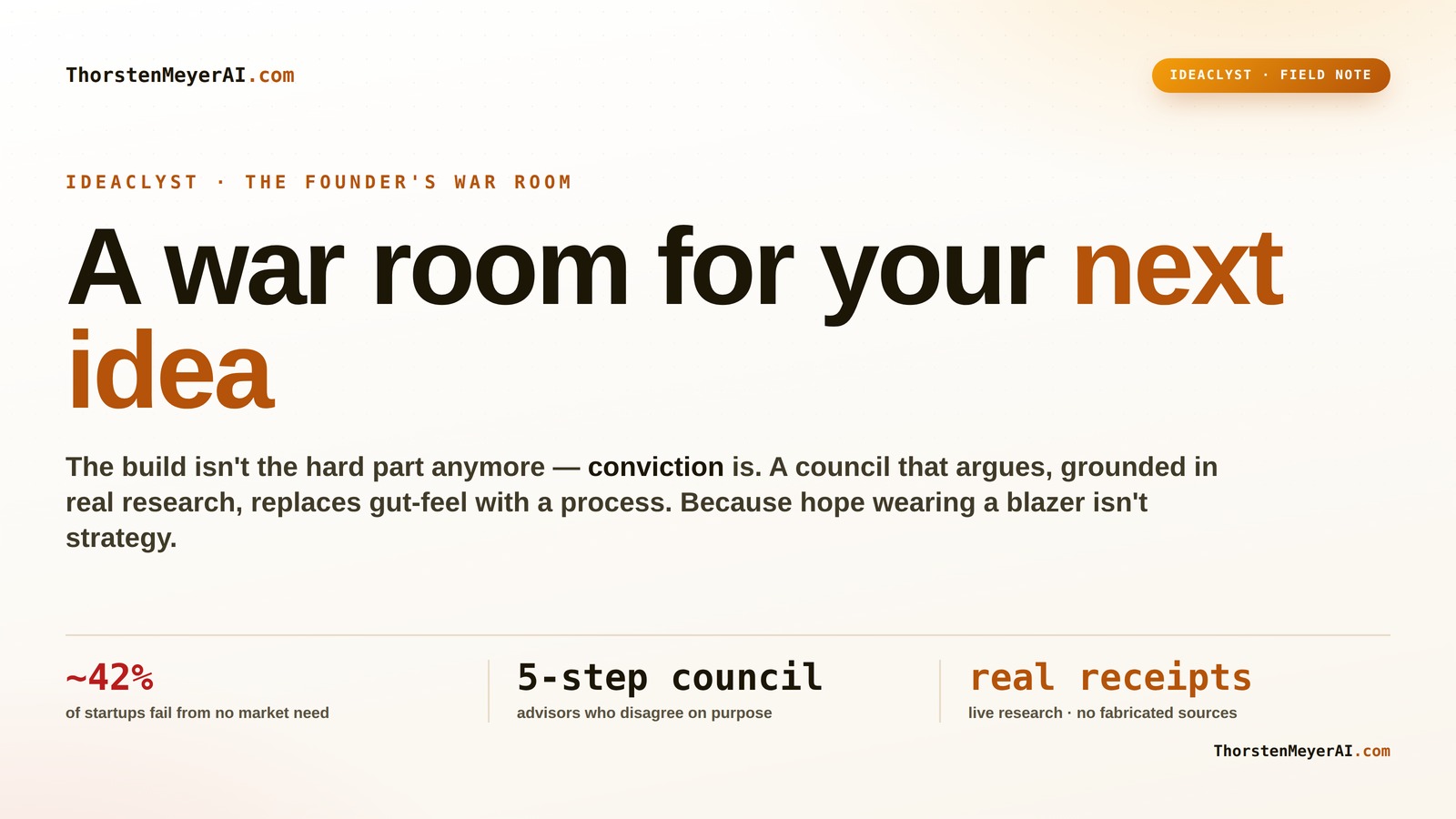
The build isn’t the hard part anymore — conviction is. Knowing which idea deserves the next six months, and being able to defend it. Most founders answer with gut feel and optimistic math. That’s hope wearing a blazer. IdeaClyst replaces it with a process.
The most expensive decision is what to build
The single most valuable thing a tool can do is talk you out of the wrong six months. The numbers make the case better than any pitch.
Three tools in one — on your own machine
Strip away the framing and IdeaClyst is three things at once, all running locally with nothing leaving your laptop.
An AI council
Pressure-tests an idea you bring it — advisors who argue on purpose.
A discovery engine
Finds ideas you didn’t know to look for by hunting real demand signals.
A founder’s workspace
Carries winners from “interesting” all the way to “ready to build.”
Advisors who disagree on purpose
Not one confident, agreeable answer — a structured five-step deliberation where models play different roles and turn on their own work. The disagreement is the feature.
The five-step deliberation
A council that leads with the bad news surfaces the objections you’d otherwise find the expensive way, on month five.
Product strategy
Who’s it for, what’s the wedge, why now, what’s the business model.
Technical architecture
What would it actually take to build — and where’s the risk.
Critique pass
The council turns on its own work. Where’s the hand-waving? What kills this?
Second, independent critique
A different voice, a different angle — so blind spots don’t survive.
Final synthesis
Everything into one coherent founder packet: strategy, architecture, validation, plan.
When IdeaClyst cites a source, it actually fetched it
The hard departure from “ask an AI what it thinks of my startup.” It runs in a strict, real-data-only mode — if it can’t gather genuine evidence, it says so plainly rather than inventing a plausible paragraph.
Confidence with receipts
No fabricated statistics, no imaginary competitors, no made-up citations. The packet survives a skeptical co-founder or a sharp investor because the reasoning has receipts.
Market research first
Scouts the landscape before the council reasons about anything.
Competitor read
Real positioning, pricing signals, feature claims — differentiation vs. reality.
Validation with links
Not “talk to customers” — concrete signals & sources you can click.
From the blank page to build-ready
Evaluation is half the problem; the blank page is the other half. And a plan is worthless if it dies in a tab you never reopen.
Bring a space, not an idea
“AI for accountants,” “tools for indie game studios” — plus your goal and real capacity. It hunts demand signals across HN, Reddit, Product Hunt, GitHub, pricing pages.
- An honest market read — leads with the bad news when a space is hard
- An opportunity map — high pain, thin competition
- Ranked candidates — wedge, who pays, effort, risk, confidence
- each with KILL CRITERIA — when to walk away
A home and a forward path
Every promising idea gets carried forward, with every artifact in plain files on your disk.
- Validation tooling — sprint board, interview list, evidence browser
- Founder profile — a personal-fit lens; same discovery, different advice
- Build workspaces — funnel, personas, landing draft, version history
- “Build this idea” → a PRD + task queue, ready for a coding agent
Key Takeaways
- IdeaClyst creates a structured, debate-driven space that turns fuzzy ideas into clear, defendable plans.
- Its AI council’s disagreement surfaces risks and blind spots founders often miss, saving time and money.
- Grounding in live web research ensures ideas are tested against current market realities, reducing overconfidence.
- Running entirely on your machine keeps your data private and under your control, ideal for sensitive projects.
- In 2026, AI-driven idea validation is faster, cheaper, and more reliable — making your next move smarter.
local AI-powered idea management software
As an affiliate, we earn on qualifying purchases.
As an affiliate, we earn on qualifying purchases.
What is a War Room for Ideas — and Why You Need One
Think of a war room as your command center — a space where every piece of intel, strategy, and feedback converges. IdeaClyst transforms this concept into a digital workshop where your ideas get the full treatment. Instead of relying on gut feelings or scattered notes, you conduct structured debates, gather real-time research, and build a plan that’s bulletproof.
For example, imagine a founder brainstorming a new SaaS product. With IdeaClyst, they input the core concept, and the system’s AI councils challenge assumptions, surface risks, and find hidden opportunities — all on their own machine. The result? A clear, confident plan that’s ready to move from idea to execution.
As an affiliate, we earn on qualifying purchases.
How IdeaClyst Structurally Turns Ideas Into Action
IdeaClyst doesn’t just hold ideas — it guides you through a deliberate process. Here’s how it works:
- Capture: Jot down your initial idea in a few words or a paragraph.
- Council Deliberation: The AI council stages a structured debate, with different models playing roles — product strategist, tech architect, critic, and synthesizer.
- Research & Validation: It pulls in live web data, facts, and trends, grounding your assumptions in real-world evidence.
- Refinement: The council challenges weak spots, tests risks, and suggests improvements.
- Final Plan: The system compiles a clear, markdown-based plan you can use for pitching or building.
This step-by-step approach turns fuzzy ideas into a solid blueprint, all stored safely on your local machine.
team collaboration war room software
As an affiliate, we earn on qualifying purchases.
As an affiliate, we earn on qualifying purchases.
The AI Council: Disagreeing for Better Ideas
Most AI tools just say ‘yes’ — but IdeaClyst’s secret weapon is its council of AI advisors that argue with each other. Each one takes a different role: one questions your market assumptions, another critiques your tech approach, a third highlights overlooked risks.
Why does this matter? Because in real-world decision-making, relying on a single perspective often leads to blind spots. By encouraging disagreement, IdeaClyst exposes weaknesses and tests your ideas from multiple angles. This process creates a more comprehensive understanding of potential pitfalls and opportunities, which ultimately leads to stronger, more resilient strategies. It’s a form of built-in critical thinking that helps founders avoid costly mistakes and overconfidence.
For example, a founder considering a social-impact app might get one model praising its potential, while another warns about regulatory hurdles. The clash of opinions forces you to confront weaknesses early, saving time and money.
This deliberate disagreement creates a more nuanced, resilient plan, instead of a single, possibly biased answer. It’s like having a board of skeptics, all on your own laptop.
idea validation tools for startups
As an affiliate, we earn on qualifying purchases.
As an affiliate, we earn on qualifying purchases.
Grounded in Real Research, Not Just Model Guesswork
One of IdeaClyst’s biggest strengths is its commitment to real data. Many AI tools answer based on memory or vague trends, but IdeaClyst pulls live web research into its deliberations. This means your ideas are tested against current market conditions, competitor moves, and recent news.
Why is this important? Because relying solely on static or outdated data can give a false sense of certainty, leading to decisions that don’t reflect the current landscape. By integrating live research, IdeaClyst ensures your strategies are based on the latest, most relevant information. This reduces the risk of pursuing ideas that are no longer viable or ignoring emerging opportunities.
For instance, if you’re exploring a new telehealth platform, the system scans recent industry reports, user sentiment, and regulatory updates to validate or challenge your assumptions. According to recent data, telehealth grew over 38% in 2025 alone, making it a hot space worth considering here.
This grounding in facts prevents the all-too-common trap of overconfidence based on outdated or biased information, encouraging more realistic and adaptable planning.
Why Local-First Matters for Founders
Unlike most AI tools that store your ideas in the cloud, IdeaClyst runs entirely on your machine. All data, reports, and plans are saved as plain files — no cloud account, no API keys, no subscription. This local-first approach is a game-changer for privacy and control.
Why does this matter? Because in today’s digital landscape, data breaches and privacy concerns are more prevalent than ever. Storing sensitive ideas locally means you retain full control over your data, dramatically reducing the risk of leaks or unauthorized access. Additionally, working offline ensures you’re not dependent on internet connectivity or third-party servers, which can be unreliable or vulnerable to outages. This approach empowers founders to operate securely and confidently, especially when dealing with proprietary or confidential information.
For example, one nonprofit founder used IdeaClyst to refine a community outreach program, confident that all their research stayed local, and their data wasn’t floating around in someone else’s cloud. This control can be critical when dealing with sensitive stakeholder information or proprietary innovations.
Who Should Use IdeaClyst — And Why It’s Worth It
IdeaClyst is perfect for founders, product teams, social entrepreneurs, and anyone with big ideas that need disciplined evaluation. If you’ve ever felt stuck, unsure whether your idea is worth pursuing, this tool gives you a structured, evidence-backed way to decide.
Why does this matter? Because in the fast-paced world of startups and innovation, hasty decisions based on gut feelings can lead to costly mistakes. By providing a rigorous process grounded in live data and structured critique, IdeaClyst helps you make smarter choices faster. It reduces the risk of chasing dead-end ideas and helps you focus on opportunities with real potential. For lean teams especially, this means saving time, money, and resources while increasing your chances of success.
Imagine a social-impact startup that’s considering expanding into a new region. Instead of relying on guesswork, they input their idea, and the AI council surfaces the latest data, local challenges, and strategic critiques. The result? A confident go/no-go decision, backed by evidence and critical analysis.
It’s especially valuable for teams that want to avoid costly pivots or missteps. With IdeaClyst, you get a clear, defendable plan that helps you act decisively and with confidence.
Why Now — The Big Shift in Idea Validation and Strategy
In 2026, rapid AI and web research have made idea validation faster, cheaper, and more reliable. A traditional validation process might take months and cost thousands, but now, a founder can get a solid read in hours with IdeaClyst.
Why does this matter? Because the ability to quickly test and iterate ideas means founders can respond more agilely to market shifts, reducing wasted effort and increasing their chances of success. The tradeoff, however, is that faster validation requires more disciplined use of tools like IdeaClyst to avoid jumping to conclusions. It’s a balance between speed and thoroughness—where the right process ensures rapid yet reliable results. This shift empowers startups to compete in a landscape where speed often determines survival, but quality still counts.
For example, a startup founder exploring a new AI-powered health app used the tool to gather live data, critique assumptions, and finalize a go-to-market strategy in just two weeks — something that would have previously taken months.
This shift means founders can move faster, test ideas more rigorously, and pivot with confidence — all while keeping their data local and secure.
Key Questions About IdeaClyst — And Clear Answers
- What is IdeaClyst? It’s a local-first, AI-powered war room for ideas, guiding founders through structured debates, research, and planning. Its design emphasizes secure, private, and grounded decision-making, which matters because the quality of your ideas depends on the integrity of your process and data. Using local storage minimizes risks associated with cloud data breaches or outages, ensuring your strategic work remains fully under your control. This focus on security and reliability is especially crucial for sensitive projects or proprietary innovations.
- How does it differ from regular brainstorming tools? It stages structured disagreements among AI models, grounds ideas in live data, and produces a comprehensive plan stored locally. These features encourage deeper analysis, reduce biases, and improve decision quality, which are essential for high-stakes projects where surface-level insight isn’t enough. This makes IdeaClyst not just a brainstorming app, but a strategic partner that elevates your idea development process.
- Can teams collaborate? Yes, as long as they share the files, since everything is stored as plain Markdown files on your device. This approach offers flexibility and control, enabling distributed teams to work together without relying on cloud platforms or risking data leaks. It also allows for version control and offline work, which are critical for maintaining the integrity and security of your strategic documents.
- Is it suitable for social-impact or nonprofit work? Absolutely. Its focus on grounded validation and secure data makes it ideal for mission-driven projects. For organizations where trust, privacy, and accuracy are paramount, IdeaClyst provides a reliable environment for strategic decision-making that aligns with their values and operational needs.
Frequently Asked Questions
What exactly is IdeaClyst?
IdeaClyst is a local-first, AI-powered workspace designed specifically for founders and teams to evaluate, critique, and develop ideas through structured debates and real-time research. It helps turn fuzzy concepts into actionable plans.How does the AI council improve my idea?
Instead of just accepting your assumptions, the council stages disagreements among different AI models, surfacing risks, blind spots, and opportunities you might miss. This process makes your plan more resilient and credible.Can I use it with my team?
Yes, as long as your team shares the same files stored locally on your machine. It’s designed for collaboration through shared Markdown files, not cloud-based lock-in.Is it suitable for social-impact projects?
Absolutely. Its emphasis on grounded research, privacy, and structured critique makes it ideal for social entrepreneurs and nonprofits who need reliable, secure decision-making tools.Why is local-first architecture important?
It keeps your data private, secure, and under your control. Especially for sensitive or proprietary projects, working locally prevents leaks and dependency on third-party servers.Conclusion
Imagine a space where your ideas are challenged, validated, and refined with razor-sharp clarity. That’s what IdeaClyst offers — a personal war room that turns uncertainty into confidence.
If you’re serious about making your next idea stick, get a grip on your process, and own your data, this tool could be your secret weapon. Because in the end, the best ideas aren’t just the loudest — they’re the most carefully tested.
Fall Picks
fall essentials
As an affiliate, we earn on qualifying purchases.